Evergreen Learning: What Pedagogy and Andragogy Share, and Where They Grow Apart
A Winter Morning and a Quiet Lesson About Growth
A thin layer of frost covered the ground outside the conference center on the morning the leadership team gathered for their yearly planning retreat. The hallway smelled faintly of coffee. People arrived in scarves and gloves, brushing cold air from their sleeves, settling into chairs with the slow exhale that only winter encourages.
The facilitator placed a small evergreen branch at the center of each table. No explanation. Just a simple, unexpected visual. Several managers whispered questions. A few smiled. The room softened.
A quiet message began forming inside that moment. Rather than being seasonal, learning should last and behave more like an evergreen, growing through every condition, steady in its purpose, adapting to whatever the environment brings.
The branch pointed to endurance, illustrating how life continues even in stillness.
Every person in that room carried a different story of how they learned to lead. Some carried the memory of formal schooling and childhood classrooms. Some carried the memory of mentors, mistakes, and self-driven growth. All of them carried a mix of pedagogical roots and andragogical branches.
The facilitator’s choice created the perfect starting point for understanding how learning grows across a lifetime and why adult learning deserves its own design.
Neuroscience has a lot to say about that. Research from Kolarik et al. (2018), Bjork and Yue (2022), Tyng et al. (2017), and Immordino-Yang and Cain (2019) show that memory, motivation, context, purpose, and emotional relevance shape learning at every age. The brain changes as we grow, yet some principles remain evergreen.
The winter season outside the window mirrored that truth. A quieter landscape can reveal what matters most.
Evergreen Principles That Guide All Learning
Three evergreen principles anchor every learning experience whether someone is six years old or 106 years old:
Relevance strengthens attention.
Emotion fuels memory formation.
Practice and repetition create durable skill.
These principles behave like the deep roots of an evergreen tree. They remain constant even as the branches shift with the seasons of life.
Pedagogy and andragogy approach these principles differently, yet both recognize their importance. The difference lies in how much ownership the learner has and how much the learning environment honors autonomy, purpose, and lived experience.
A strong understanding of both models helps learning designers create environments where people thrive.
A Glimpse Into How Learning Lives in Real Work
A manager sat at her desk reviewing two modules. One module taught safety procedures to a group of new teenage interns. The other prepared mid-career engineers for a systems upgrade. Both modules had the same three evergreen principles at the core: relevance, emotion, and practice.
The difference showed up in the design choices. The interns needed structure, modeling, guided steps, and concrete examples. The engineers needed ownership, rationale, options, and real-world application.
The manager noticed something across both projects. Learning flourished whenever relevance was clear, emotions were acknowledged, and people had space to activate new knowledge. Neuroscience consistently supports these ideas. Emotional relevance activates the amygdala which enhances encoding in the hippocampus (Tyng et al., 2017). Spaced practice strengthens long-term memory consolidation (Vlach et al., 2018). Purpose and autonomy increase dopaminergic motivation systems that support persistence and cognitive flexibility (Bromberg-Martin & Monosov, 2020).
Pedagogy and andragogy both need these systems. They simply distribute responsibility differently.
How Pedagogy and Andragogy Are Similar: The Evergreen Core
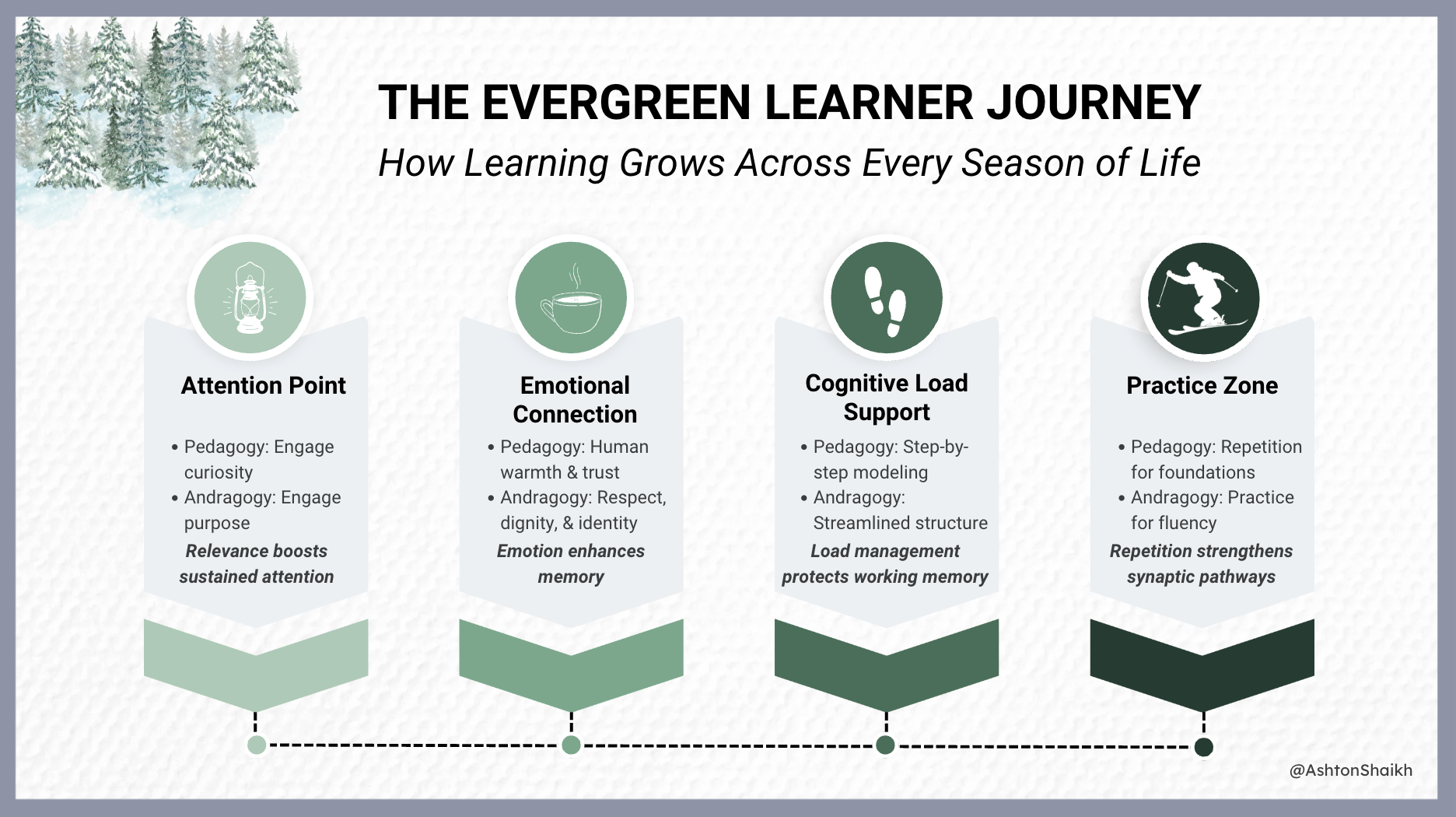
1. Both rely on clear structure
Children learn through structured pathways because their cognitive and executive functions are still developing. Adults benefit from structure for different reasons. Stress, workload, burnout, and role complexity naturally reduce working memory capacity. A clear structure supports cognitive efficiency for everyone. Neuroscience research shows that structure reduces cognitive load and supports prefrontal cortex function during complex tasks.
2. Both benefit from emotional connection
Emotion is a core part of being human. Whether a learner is eight or 108, emotional engagement directs attention and enhances memory. A relatable scenario, a story, or a moment of shared humanity signals that the learning matters. Immordino-Yang and Cain (2019) demonstrated that emotional meaning influences large-scale neural networks responsible for attention, reflection, and meaning-making.
3. Both require practice for real mastery
Children practice to build foundational skills. Adults practice to improve fluency in high-stakes environments. The mechanism is the same. Repetition strengthens synaptic pathways, supporting long-term retention (Kolarik et al., 2018).
4. Both benefit from social learning
Collaborative meaning-making enhances encoding and transfer. Peer discussion, modeling, feedback, and shared exploration strengthen memory pathways for all ages. Social connection activates reward pathways, enhancing motivation and problem-solving. These similarities show that pedagogy and andragogy grow from the same evergreen foundation. The difference lies in how the branches adapt to the learner’s stage of life.
How Pedagogy and Andragogy Differ: The Growth Shifts
1. Ownership of learning shifts dramatically
Children rely on educators to determine goals. Adults respond best when they shape their own. Self-directedness activates intrinsic motivation networks in adults. Research on autonomy and agency shows that choice increases engagement and effort (Murayama et al., 2018).
2. Experience becomes a primary resource for adults
Children build knowledge through exploration that educators plan. Adults build new knowledge by integrating it with lived experience. A workplace learner compares new information with their history, identity, and professional reality. This integration process creates stronger retention.
3. Purpose becomes non-negotiable for adults
Children tolerate learning that prepares them for future possibility. Adults need learning that solves immediate problems. Neuroscience confirms that immediate relevance increases dopaminergic motivation, supporting deeper cognitive engagement (Westbrook & Braver, 2016).
4. Adults require psychological safety differently
Children rely on emotional safety to take risks. Adults require psychological safety to protect dignity, identity, and professional reputation. Fear disrupts working memory and decreases learning efficiency (Shackman et al., 2016). Supportive environments protect cognitive bandwidth.
5. Adults need flexibility in pace and method
Children benefit from consistent routines. Adults need flexibility due to workload, cognitive fatigue, and deadlines. Adaptive design respects the adult learner’s life context. Pedagogy and andragogy share a foundation, yet the branches respond to different climates.
The Evergreen Structure
Picture a winter training session inside a manufacturing plant. The floor outside buzzes with activity while a group of new hires settles into a warm conference room that smells faintly of machine oil and cocoa from a breakroom dispenser. Two learners sit near the front.
A young apprentice named Lucas arrives with a notebook already open. He waits for direction, eager for clarity. His mind looks for structure. A seasoned technician named Maria sits beside him. She scans the agenda. Her mind looks for relevance and connection to the real challenges on the floor.
The trainer begins with a compelling scenario: a small mistake on Line C caused a chain of delays last winter. The story is human, relatable, and grounded in purpose.
Lucas leans forward because stories help him understand context. Maria leans forward because the scenario connects to her lived experience. Both learners become engaged, but for different reasons. The trainer offers guided steps, hands-on practice, moments of troubleshooting, and opportunities to discuss real situations.
Lucas benefits from modeling and repetition. Maria benefits from autonomy and problem solving. Both benefit from emotional relevance and clarity.
The session succeeds because the trainer honors the evergreen principles underneath pedagogy and andragogy. The session adapts to the winter season of each learner’s life.
Designing Evergreen Learning Inside Organizations
Every organization can strengthen learning environments by honoring these ideas.
1. Start with purpose learners can feel
Purpose activates motivation networks and improves retention. Whether the learner is a new hire or a senior director, purpose creates a cognitive anchor.
2. Acknowledge emotion as a learning tool
A real story. A moment of honesty. A challenge learners recognize. These elements support the brain’s natural encoding systems.
3. Reduce cognitive load through clarity
Simplifying structure supports working memory for all learners, regardless of age or role.
4. Create choice whenever possible
Choice supports adult self-direction and reduces perceived threat.
5. Integrate lived experience
Adults thrive when learning connects to reality. Children thrive when learning connects to exploration. Both benefit when learning connects to humanity.
6. Provide steady practice
Practice creates durable memory and real-world skill.
7. Build a culture where learning is continuous
Evergreen learning becomes possible when organizations stop treating learning as a single season and start treating it as a steady cycle of growth.
Evergreen Learning as a Human Invitation
A winter morning often brings a quiet stillness that makes people pause. That stillness mirrors the pause that learners appreciate whenever a trainer or leader slows the pace, clarifies the purpose, or creates a moment of reflection. Pedagogy and andragogy differ in their approach, yet both serve the same intention. Both ask a simple question.
What helps this person grow?
An evergreen approach to learning design answers with clarity, compassion, and respect for how the brain naturally learns. Learning that honors neuroscience creates the cognitive conditions people need to feel supported, while learning that honors humanity provides the emotional grounding that helps people feel empowered. Together, these approaches form evergreen practices that sustain growth over time.