The Myth of Learning Styles, And the Science That Liberates Learning
For decades, educators and corporate trainers have been told to design learning experiences that match each learner’s “style”: visual, auditory, or kinesthetic (and in some cases, even more boxes added). The idea was comforting, because if we could just discover how someone learns best, we could tailor instruction and unlock their potential.
But the real story of how the brain learns is even more hopeful than that.
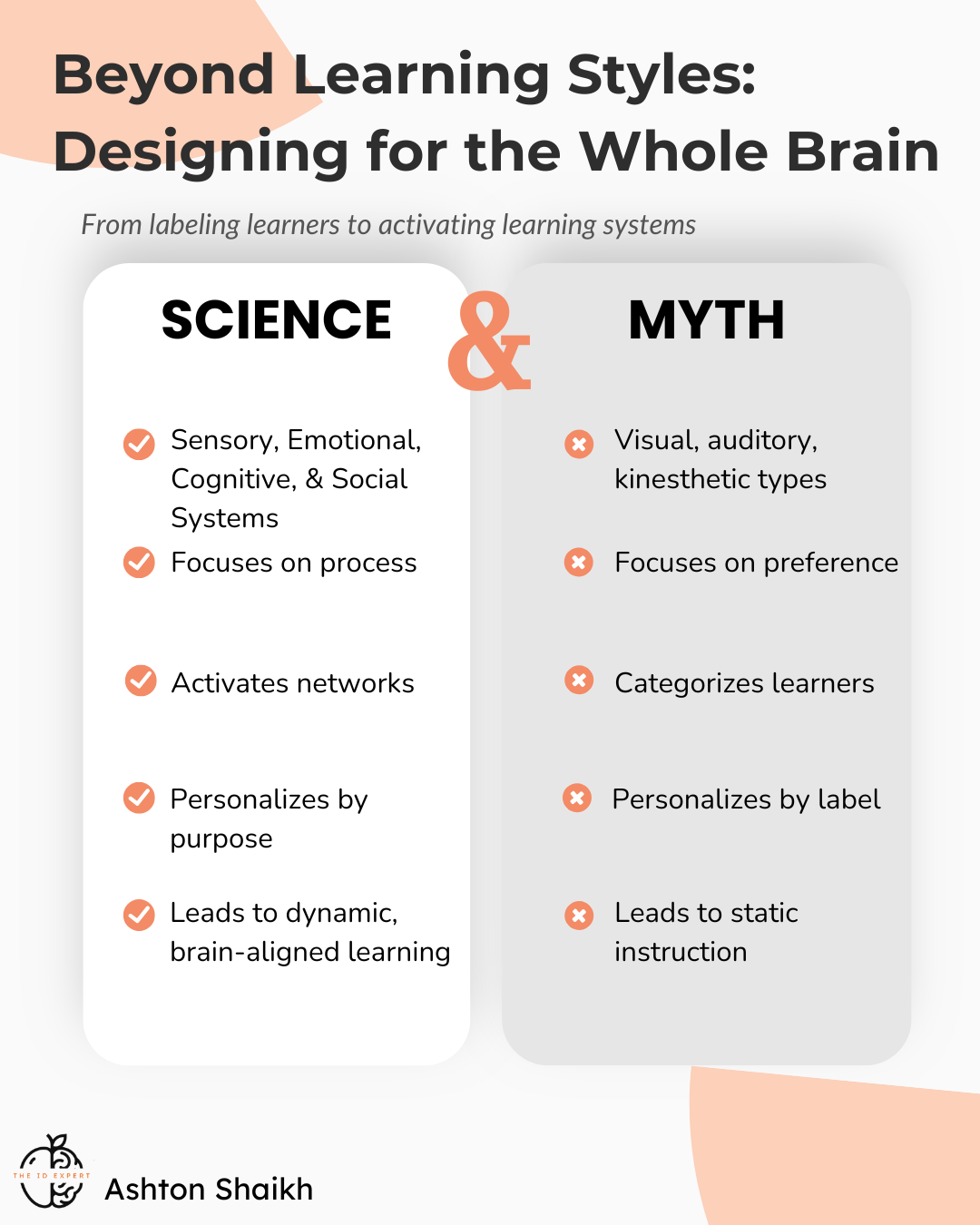
Neuroscience shows that learning is not confined to a single channel or preference, but rather a full-brain experience that thrives on connection, curiosity, and meaning. The brain constantly creates understanding, drawing on sensory, emotional, and cognitive systems working in harmony.
When we look beyond learning styles, we uncover a richer form of personalization. We begin to design learning that mirrors how the brain naturally integrates experience: through vision, language, movement, emotion, and purpose, all woven together into one unified act of making sense of the world.

9 Ways the Brain Learns: Reimagining Gagné’s Events of Instruction
According to the LinkedIn Workplace Learning Report (2023), only 25% of employees apply what they learn in training after two weeks, and fewer than 15% retain that information after a month. Rather than a limitation, those numbers remind us of what’s possible. They highlight a tremendous opportunity to design learning that translates into sustained performance, learning that reflects how the brain naturally engages, encodes, and recalls information.
When instruction is designed with the brain in mind, engagement deepens, retention strengthens, and performance improves where it matters most. Traditional training has often focused on delivering information, but the science of learning shows a clear path forward: design for cognition, not just content.
Robert Gagné’s Nine Events of Instruction remain one of the most practical bridges between theory and practice, especially when reimagined through the lens of modern cognitive and behavioral neuroscience. Gagné’s framework stands the test of time, inviting today’s designers to rethink and reapply its principles through the lens of modern neuroscience.
Even decades after their publication, Gagné’s events describe not just how good instruction feels, but how the brain actually processes, encodes, and recalls new information.

4 Ways the Brain Decides What Deserves Attention
We’ve all had those days when we’re working hard but not really moving forward. You cross off tasks, respond to messages, and stay busy, but at the end of the day, the progress just doesn’t match the effort.
You’re not doing anything wrong. The brain’s default mode is reaction before reflection.
The limbic system loves urgency, alerts, and quick rewards. It’s the part of the brain that lights up when something feels immediately important: a notification, an email, or a sudden “fire to put out.”
The prefrontal cortex, on the other hand, handles planning, focus, and long-term thinking. It helps you set goals, prioritize, and connect today’s actions to tomorrow’s results.
The two are constantly negotiating who’s in charge, and that’s where focus can get lost.